If you have opened LinkedIn, Instagram, or even a random blog lately, you have probably felt it that strange sense that everything sounds a little… the same. Same punchy hooks, same “game-changer” adjectives, same bullet-point wisdom. That is AI content saturation, and in 2026 it is not a future problem anymore. It is here, right now, in your feed.
Quick answer: To make your content stand out in 2026, you need to combine AI tools for speed with real human experience, opinion, and original data for depth. AI can draft, research, and structure but the standout factor comes from what only you can add: lived experience, a distinct point of view, and proof that a real person (or brand) stands behind the words.
I am Sujith, and I write about AI tools daily, testing everything from ChatGPT to Claude to half a dozen lesser-known apps. This article is not theory it is what has actually worked for me and for creators I follow closely in India’s fast-growing content space.
Why Everything Sounds the Same Right Now
Tools like ChatGPT, Gemini, and Claude have made writing genuinely easy. That is a good thing for productivity. But it also means thousands of creators are typing near-identical prompts like “write a blog post about digital marketing tips” and publishing whatever comes out, with barely any editing.
The result is a flood of content that is grammatically correct but forgettable. Search engines and readers are both getting better at spotting it. Google’s helpful content guidance has repeatedly emphasized rewarding content that shows real experience, not just information assembled correctly.
So the problem in 2026 is not “will AI replace writers.” It is “how do I use AI without sounding like everyone else who is also using AI.”
What Actually Makes Content Stand Out Now
1. Lead With Experience, Not Just Information
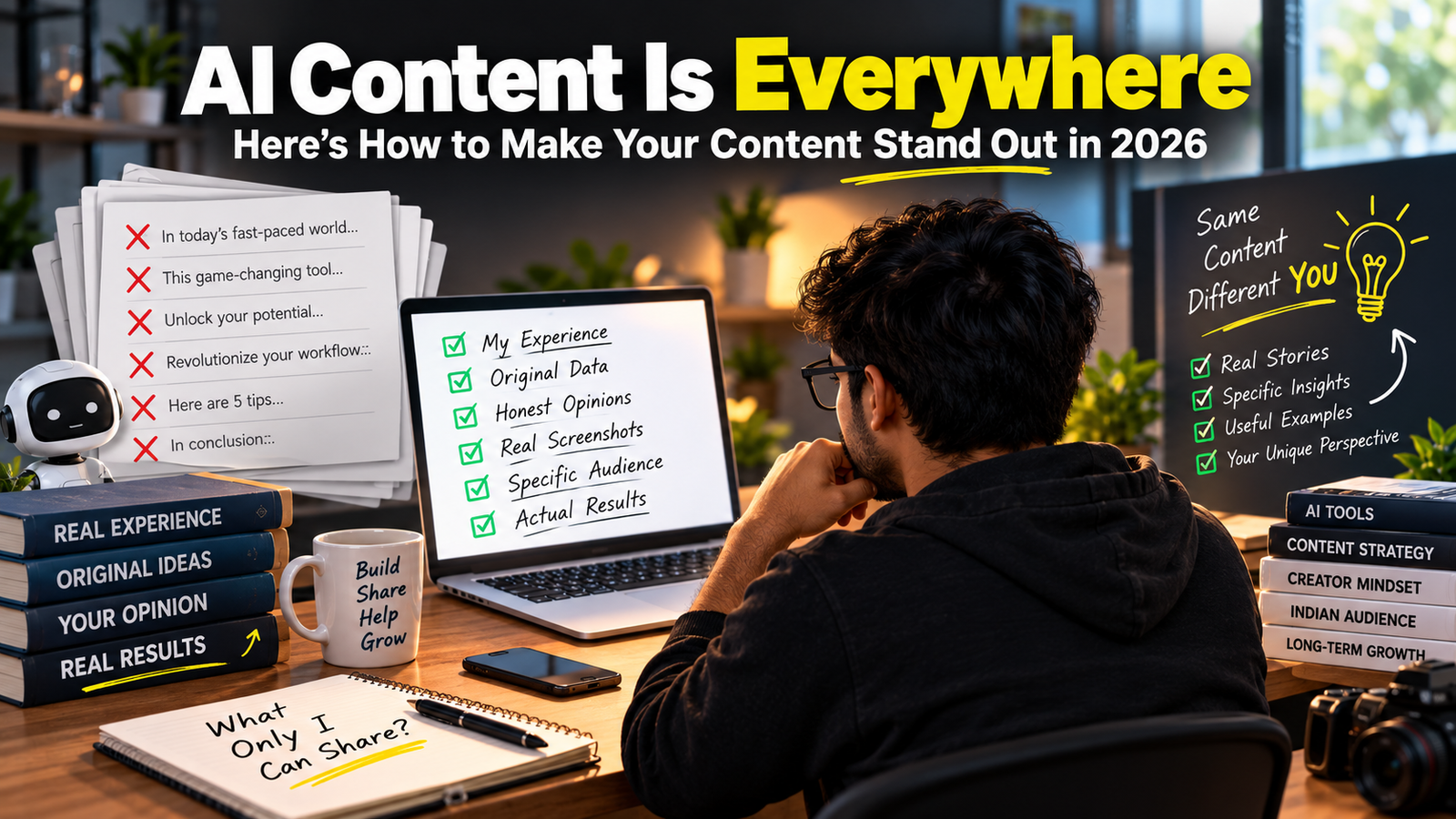
Anyone can ask an AI model to explain “how to start a YouTube channel in India.” Very few people can say, “I started my channel with a Rs. 8,000 phone and a ring light from Amazon, and here is exactly what happened in the first 90 days.”
That second version wins every time with readers and increasingly with search rankings because it cannot be replicated by a prompt alone.
Practical way to do this: Before you even open ChatGPT or Claude, jot down three personal details connected to your topic a mistake you made, a number from your own results, or a tool you tested. Feed these into your draft manually. AI can help you phrase them well; it cannot invent them for you.
2. Use AI as a Drafting Partner, Not a Ghostwriter
There is a difference between:
- Typing one prompt, copying the output, and publishing it
- Using AI to brainstorm structure, generate a rough first draft, then rewriting 40–50 percent of it in your own voice
The second approach is far more sustainable for standing out. Most professional writers I know now treat tools like Claude or ChatGPT the way they’d treat a smart intern useful for a first pass, but not the final voice.
3. Add Original Data or Screenshots
If you are reviewing an app, take your own screenshots. If you are comparing pricing, check the official page yourself the same week you publish (pricing on AI tools changes often what was free in January might be a paid tier by June). This single habit separates trustworthy reviewers from content farms.
4. Write for a Specific Reader, Not “Everyone”
Generic AI drafts tend to address a vague global audience. If you are writing for Indian students, marketers, or small business owners, say so directly mention rupee pricing, mention data costs, mention that many readers are on 4G in tier-2 cities. This kind of specificity is very hard for AI to guess without your input, and readers notice when content actually understands their context.
A Simple Step-by-Step Workflow I Actually Use
- Research the topic manually first. Spend 15–20 minutes reading forums (like Reddit or Indian Quora threads) to see real questions people are asking.
- Use AI for structure. Ask ChatGPT or Claude to suggest 5–6 possible headings based on your research notes, not a blank prompt.
- Draft with AI, edit like an editor. Generate a rough draft, then go section by section and ask: “Would I actually say it this way?” Rewrite anything that sounds generic.
- Insert your own proof. Add a screenshot, a number, a short anecdote, or a table you built yourself.
- Run a plagiarism and originality check. Even AI-assisted content should be checked to ensure it is not too close to existing sources.
- Read it aloud once. If it sounds like a robot reading a manual, revise that paragraph.
This workflow takes maybe 20–30 percent more time than pure AI generation, but it is the difference between content that ranks and gets shared, and content that quietly disappears.
Tools That Can Help Used the Right Way
- ChatGPT (Free and Plus tiers): Good for brainstorming, outlining, and quick research summaries. The free tier is genuinely usable for short-form drafts; Plus adds faster response times and more advanced models.
- Claude: Strong at longer-form writing and holding context across a big document, useful if you’re drafting detailed guides or reports.
- Grammarly or similar tools: Useful after your draft is written, for polishing tone and catching errors not for generating the core ideas.
- Canva or similar design tools: Pairing your AI-assisted text with a genuinely designed visual (not a generic AI image) also helps content feel less templated.
A quick honest note: pricing, free-tier limits, and features on all of these tools change fairly often. Always check the official pricing page before you publish numbers in your own content do not rely on older articles, including this one, for exact current pricing.
Common Mistakes That Make AI Content Obvious
- Overusing words like “unlock,” “game-changer,” “in today’s fast-paced world,” and “seamlessly”
- Perfectly balanced bullet lists with no strong opinion anywhere
- No specific examples, numbers, or names everything stays vague
- Zero mention of downsides or limitations, which makes content feel like an advertisement rather than genuine advice
- Publishing without reading it back even once
The Bigger Picture for 2026
AI is not going to stop improving, and content volume online is not going to shrink. That means the “stand out” strategy is not about avoiding AI tools that ship has sailed for most serious creators. It is about layering something AI cannot manufacture: your specific experience, your honest opinions, your willingness to say “this tool disappointed me” or “this worked better than I expected.”
Readers, and increasingly search engines, are getting good at telling the difference between content that was assembled and content that was actually earned.
FAQ
Is it bad for SEO to use AI-generated content? Not inherently. Google has stated its focus is on content quality and helpfulness, not on how it was produced. Purely unedited, low-effort AI content tends to underperform because it lacks depth and originality, not because an AI was involved in drafting it.
Can readers actually tell the difference between AI and human writing? Often, yes especially when content lacks specific examples, personal opinions, or context relevant to the reader. Generic phrasing and overly balanced statements are common giveaways.
Should beginners avoid AI tools completely to sound more authentic? No. Avoiding AI entirely just makes writing slower without guaranteeing better quality. The goal is combining AI efficiency with your own experience and editing, not rejecting the tools altogether.
How much of an AI draft should I actually change? There is no fixed rule, but a good target is rewriting or heavily editing at least a third to half of the draft especially the introduction, examples, and conclusion, since these are where your voice matters most.
Your Next Step
Pick one piece of content you were about to publish this week. Before you hit publish, add just one thing AI could not have written on its own a personal result, a screenshot, or an honest opinion about what did not work for you. Then compare the “before” and “after” versions side by side. You will likely notice the difference immediately, and so will your readers.