
If you’ve been using ChatGPT to help with assignments, essays, or exam prep, there’s a new piece of regulation you should know about even if you’re sitting in Chennai, Mumbai, or Bangalore and not in Brussels. The European Union’s AI Act has rolled out transparency rules that change how AI tools disclose themselves, label their content, and handle your data. Since most students use global tools like ChatGPT, Gemini, or Claude, these changes affect you too, even indirectly.
Quick summary: From 2 August 2026, the EU AI Act’s Article 50 transparency rules require AI chatbots to clearly disclose that you’re talking to a machine, and AI-generated content must carry machine-readable labels identifying it as AI-made. This doesn’t ban ChatGPT for homework, but it does mean AI-generated text is becoming easier to detect and flag which matters a lot for academic honesty policies.
I’m Sujith, and I test and write about AI tools daily for this site. I’ve spent the past few weeks digging into what this EU law actually says, and more importantly, what it means practically for students who rely on AI for schoolwork. Let’s break it down without the legal jargon.
What Exactly Is the EU AI Act’s Transparency Rule?
The EU AI Act (Regulation 2024/1689) is Europe’s big attempt to regulate artificial intelligence across risk categories. Article 50 specifically deals with transparency, and it became enforceable on 2 August 2026.
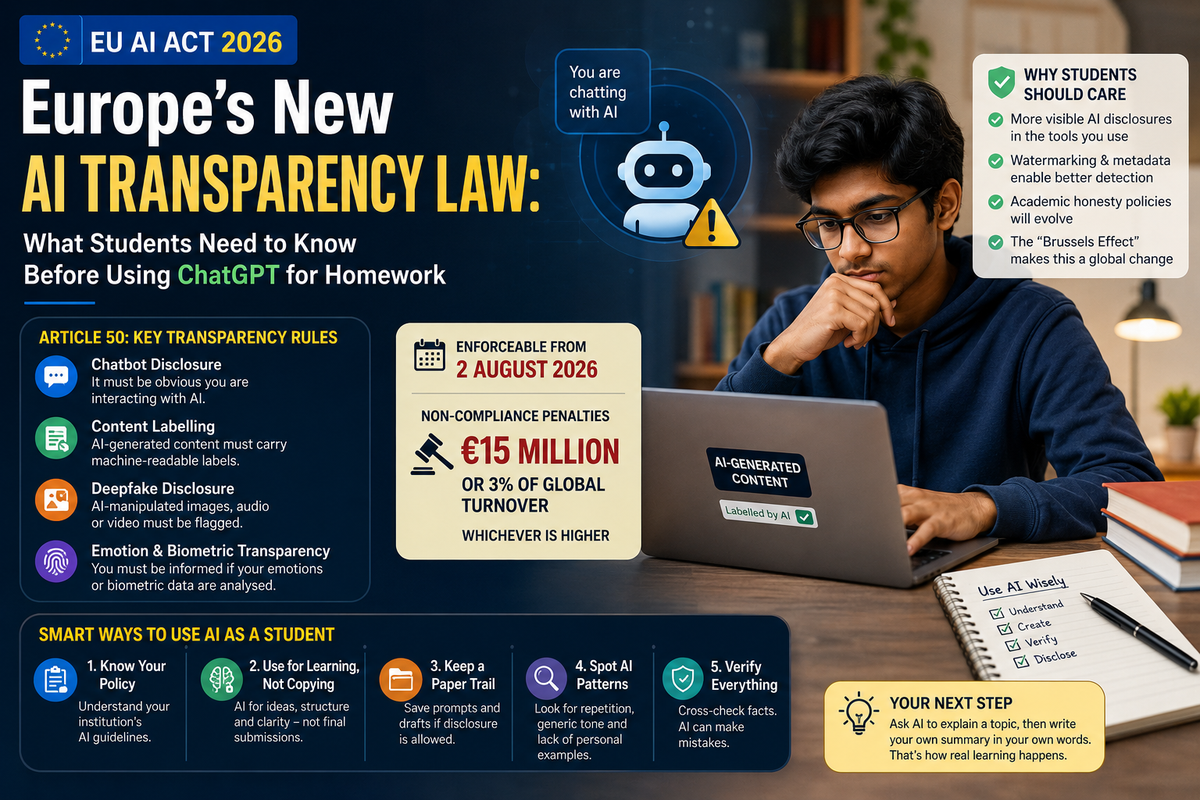
In plain terms, it requires:
- Chatbot disclosure: If you’re interacting with an AI system like ChatGPT, the provider must make it obvious you’re talking to AI, not a human unless it’s already obvious from context (a labelled chat interface usually counts as “obvious”).
- Content labelling: AI tools that generate text, images, audio, or video must mark that output in a machine-readable way so it can be detected as artificially generated.
- Deepfake disclosure: Any AI-manipulated image, audio, or video has to be clearly flagged as synthetic.
- Emotion and biometric transparency: If a system analyses your emotions or categorises you biometrically, you must be told.
Companies that don’t comply can face serious penalties up to 15 million euros or 3% of global turnover, whichever is higher. That’s a big enough number that OpenAI, Google, and other major AI companies are taking it seriously, even for users outside Europe, because building separate systems for different regions is expensive and messy.
Why Should Indian Students Care About an EU Law?
Here’s the thing — tech companies rarely build two different products for two different markets when they can just apply one global standard. This is sometimes called the “Brussels Effect”: EU regulations often end up shaping global product behavior because compliance is easier to standardize.
So even though you’re not legally bound by EU rules, you’re likely to notice:
- More visible AI disclosures in tools you already use, even on the Indian version of ChatGPT or Gemini.
- Watermarking or metadata tags on AI-generated text and images, which schools and universities can use to detect AI-written assignments.
- Clearer distinctions between “fully AI-generated” and “AI-assisted” content, a distinction the EU is actively building guidance around.
If your college is experimenting with AI-detection software (and many in India already are), these labelling standards could make detection more reliable over time not because the tools get smarter at guessing, but because AI companies are being pushed to embed identifiers directly into their output.
A Real Example From My Own Testing
Last month, I asked ChatGPT to draft a short essay on climate policy, then ran the exact same output through two different AI-content checkers. One flagged it as 88% likely AI-written; the other gave a lower score. This inconsistency is common right now — detection tools aren’t perfectly reliable, and false positives do happen, sometimes wrongly flagging human-written work too.
What the EU’s labelling push is trying to fix isn’t detection guesswork it’s trying to make the AI origin explicit at the source, through embedded markers, rather than relying on after-the-fact pattern matching. That’s a meaningful shift if it actually gets implemented well.
Should You Stop Using ChatGPT for Homework?
Not necessarily. But you should be smarter about how you use it. Here’s a simple framework I’d suggest:
Step 1: Understand your institution’s AI policy
Most Indian universities and schools now have some kind of stated AI policy ranging from an outright ban to “use with disclosure.” Read yours before you draft anything.
Step 2: Use AI for structure and understanding, not final submission
Ask ChatGPT to explain a concept, help you outline an essay, or check your grammar. Avoid submitting raw AI output as your own final work.
Step 3: Keep a paper trail
If your college allows AI-assisted work, save your prompts and drafts. This helps if you’re ever asked to show your process.
Step 4: Learn to spot AI-generated text yourself
Common tells include repetitive sentence structures, overly balanced arguments, and a lack of specific personal examples. Reading your own AI-assisted draft critically is a skill worth building.
Step 5: Cross-check facts independently
ChatGPT and similar tools can get facts wrong, especially with recent events or niche academic topics. Never treat AI output as a verified source.
Limitations Worth Knowing
No AI tool, regardless of new transparency rules, is a substitute for actually learning the material. A few honest caveats:
- Labelling standards are still being finalized by the European Commission, and enforcement details may keep evolving through 2026 and 2027.
- Not every AI tool used in India will apply EU-level disclosure by default some smaller or regional AI apps may lag behind.
- AI detection tools, even with better labelling, are not foolproof and can produce false positives or negatives.
- Pricing and features on tools like ChatGPT Plus, Gemini Advanced, or Claude’s paid tiers change fairly often, so always check current plans before assuming what’s included.
FAQ
Does the EU AI Act apply to me if I’m using ChatGPT in India? Not directly as a legal matter, but many AI companies apply global product changes rather than region-specific ones, so you’ll likely see the same disclosure and labelling features regardless of location.
Will AI-generated homework become easier to catch? It’s likely to get somewhat easier over time, as content labelling and metadata standards mature, though no detection method is currently perfect.
Is using ChatGPT for homework considered cheating? It depends entirely on your school or university’s specific AI policy. Some allow AI-assisted brainstorming with disclosure; others prohibit any AI use in graded work.
Can I still use ChatGPT for exam prep and studying? Yes using AI to explain concepts, quiz yourself, or clarify doubts is generally treated differently from using it to write graded assignments directly.
Your Next Step
Before your next assignment, open ChatGPT (or whichever AI tool you use) and try this: ask it to explain a topic from your syllabus in simple terms, then write your own summary in your own words afterward. Compare the two. You’ll immediately see the gap between “AI explained it” and “I understood it” and that gap is exactly what transparency rules like this are trying to protect.