If you have been scrolling AI Twitter or LinkedIn over the last few weeks, you have probably seen some version of this headline: new US AI rules mean product launches now require government review. It sounds dramatic, like every chatbot update from now on needs a stamp from Washington before Indian users like us can even open the app.
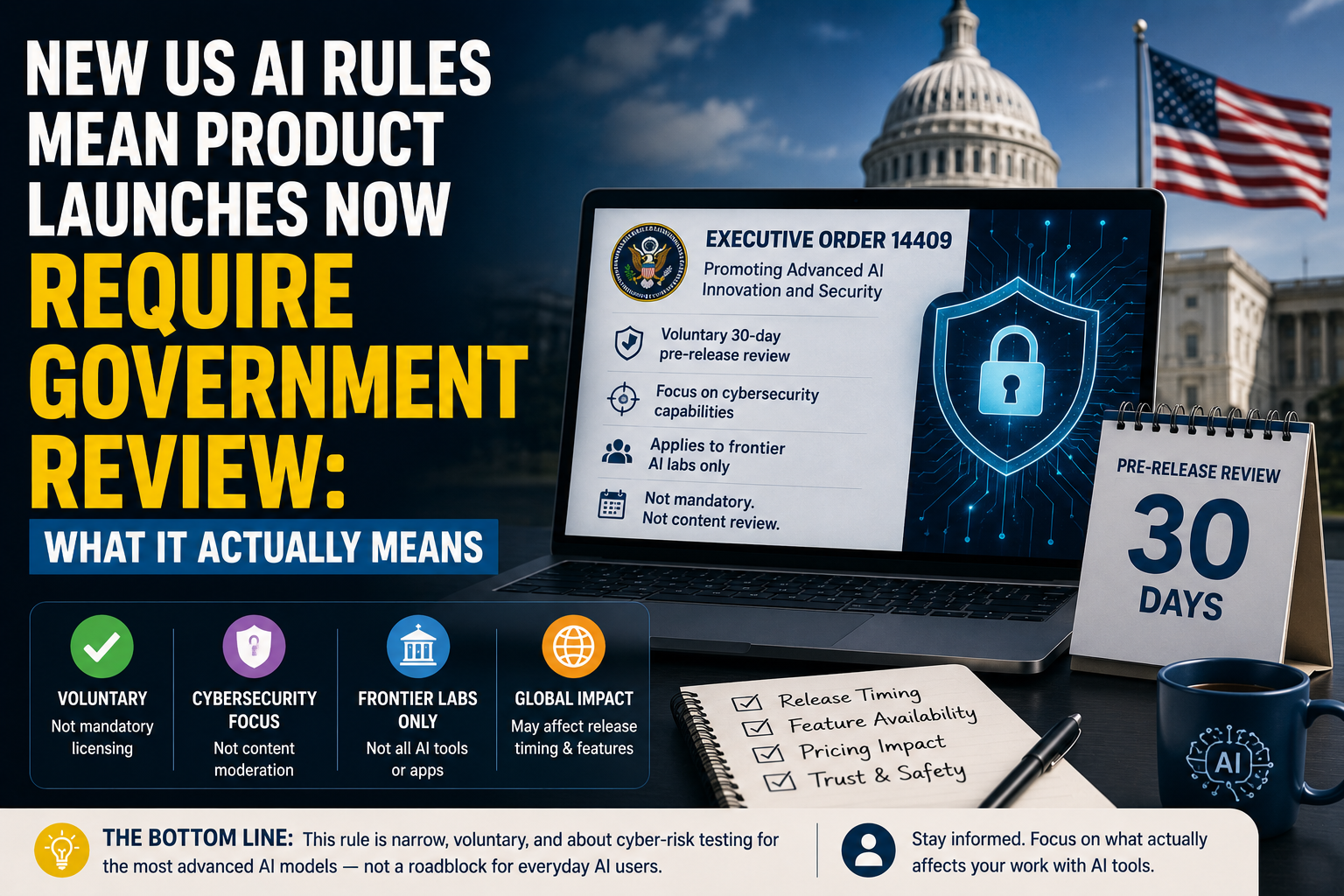
Quick answer: The new US framework, created under Executive Order 14409, is a voluntary 30-day pre-release cybersecurity check that applies only to a small handful of the world’s most powerful “frontier” AI models, not to every AI product launch. It does not touch most of the tools you and I use daily, and it is about cyber-risk testing, not content approval.
I write about AI tools for a living, and I track these regulatory shifts because they eventually affect pricing, availability, and feature rollouts for tools we use in India ChatGPT, Claude, Gemini, and the rest. So let’s break down what actually changed, who it affects, and what it means if you’re a student, marketer, or small business owner using AI tools out of Chennai, Mumbai, or anywhere else in India.
What Is Executive Order 14409, In Plain Language
On June 2, 2026, the US administration signed Executive Order 14409, titled “Promoting Advanced Artificial Intelligence Innovation and Security.” Despite the scary headline you might have read, the order does two main things:
- It pushes federal agencies to use AI more aggressively for cybersecurity defense.
- It sets up a voluntary review process where developers of the most advanced “covered frontier models” can let the government test their systems for up to 30 days before those models are released to certain trusted partners.
That’s it. There is no licensing requirement, no mandatory preclearance, and no rule that says a startup in Bangalore or a solo developer building a ChatGPT wrapper needs sign-off from any US agency.
Why People Are Calling It “Mandatory Government Review”
The confusion comes from how the order is being reported. Early drafts of AI policy in the US did consider stricter, mandatory oversight. What actually got signed is a lighter-touch version the government shortened an earlier 90-day proposed review window down to 30 days and explicitly rejected mandatory licensing. So when you see headlines implying every AI launch now needs government review, that’s an oversimplification of a narrow, opt-in program.
Who Is Actually Affected By This Rule
This is the part that matters most, so let’s be precise.
- Frontier AI labs only. The framework targets “covered frontier models” the most capable closed AI systems, built by companies like OpenAI, Anthropic, Google, and similar frontier labs. The exact technical threshold for what counts as “covered” is being defined through a classified benchmarking process, so even industry insiders don’t have a public checklist yet.
- Closed models, not open-weight models. Open-source or open-weight models, the kind many Indian developers fine-tune and self-host, are currently excluded from this review track.
- Cybersecurity capability, not general content review. The review focuses on whether a model has dangerous offensive cyber capabilities think automated vulnerability discovery or exploit generation not on whether it writes controversial essays or generates marketing copy.
- Participation is voluntary. A lab can choose not to participate. There’s no legal penalty in the order itself for skipping it, although companies working with the US government or wanting goodwill with regulators may feel pressure to opt in anyway.
So if you’re building a Canva-style design tool, a customer support chatbot for your D2C brand, or using Claude for content writing, this rule was never really about you.
What This Looks Like In Practice (A Walkthrough)
I’ve been testing frontier models like Claude and GPT since well before this rule existed, and here’s roughly how a 30-day review would play out for a lab that opts in:
- The lab finishes training a new frontier model internally and completes its own safety testing.
- Before public release, it notifies the relevant government body currently expected to be CAISI (the Center for AI Standards and Innovation, under the US Commerce Department) along with NSA involvement for cyber-specific checks.
- The government gets up to 30 days of access to test the model’s cybersecurity capabilities things like whether it can autonomously find and exploit software vulnerabilities.
- After the window closes, the lab is free to release the model publicly, regardless of whether the review is fully complete, since the order does not create a hard blocking mechanism.
- The model ships, sometimes to India and other markets simultaneously, sometimes with a staggered release depending on how the lab manages its rollout calendar.
This is why you may occasionally notice a frontier model launching in the US weeks before it becomes fully available internationally, or certain advanced features rolling out region by region. That kind of staggered release isn’t new to this rule, but this kind of pre-release window can be one more factor labs juggle.
Why This Matters For Indian Users, Even If It Doesn’t Apply Directly
You might be thinking: this is a US government process, why should someone in India care? A few honest reasons:
- Release timing. If a lab is coordinating a pre-release access window with the US government, that can be one more variable affecting when a new model version becomes available on the ChatGPT app, Claude app, or via API in India.
- Feature availability. Cyber-capability-heavy features advanced coding agents, autonomous tool-use, agentic browsing are exactly the kind of capability this framework is watching. If you rely on these features for freelance work or client projects, it’s worth knowing they sit closer to the regulatory spotlight than, say, a text summarizer.
- Pricing and plan changes. Regulatory compliance work isn’t free. Over time, if frontier labs build permanent compliance and audit teams, that cost can trickle into subscription pricing for Plus, Pro, or Team tiers. This isn’t guaranteed, but it’s a pattern worth watching rather than assuming will never happen.
- Trust signals. For businesses evaluating whether to build on a particular AI provider’s API, knowing whether that provider participates in recognized safety and security review processes can be a small but real trust factor, similar to checking for SOC 2 compliance today.
Limitations And Open Questions
Being balanced here matters, because this is a fast-moving area and I don’t want to overstate certainty.
- The exact definition of a “covered frontier model” was expected to be finalized around August 1, 2026, but as with most classified benchmarking processes, the public doesn’t get full visibility into the criteria.
- It’s unclear how open-weight models with frontier-level capability will eventually be treated; there has been public discussion about whether they should be exempt or included.
- The framework has no independent public reporting requirement, so we largely have to rely on company statements and government confirmations rather than a transparent published record.
- This is an executive order, not a law passed by Congress, so a future administration could modify or repeal it. Nothing here should be treated as permanent.
If you’re building a product or business around AI tools, don’t restructure your entire workflow based on this. Treat it as background context, not a compliance requirement for your own app.
Frequently Asked Questions
Does this rule mean every new AI app needs US government approval before launch? No. It applies narrowly to a small set of the most advanced frontier AI models from major labs, and participation is voluntary. Most AI apps, wrappers, and tools built on existing APIs are unaffected.
Will this delay ChatGPT, Claude, or Gemini updates reaching India? It’s possible for specific frontier model releases if a lab opts into the 30-day review window, but there’s no fixed rule that delays every update. Many feature rollouts will continue on their normal schedule.
Is this the same as content moderation or censorship review? No. The framework is focused on cybersecurity capability testing, such as whether a model can find or exploit software vulnerabilities, not on reviewing the model’s opinions, writing style, or general content output.
Should Indian small businesses or freelancers using AI tools worry about compliance? Generally, no. This executive order creates obligations, if any, for the AI labs themselves, not for end users or businesses simply using tools like Claude or ChatGPT through their apps or APIs.
What To Do Next
Don’t panic-read every AI regulation headline as if it changes your daily workflow overnight; most don’t. What I’d actually do next: pick one frontier AI tool you already use, like Claude or ChatGPT, and check its official trust or safety page for any public statement about participation in government review frameworks. It takes five minutes and gives you a much clearer picture than any headline will.
Written by Sujith, who tests AI tools daily and tries to translate policy noise into what actually matters for people using these tools in India.