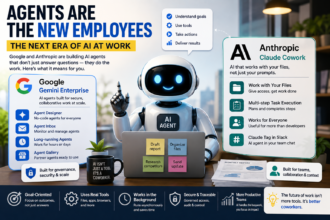
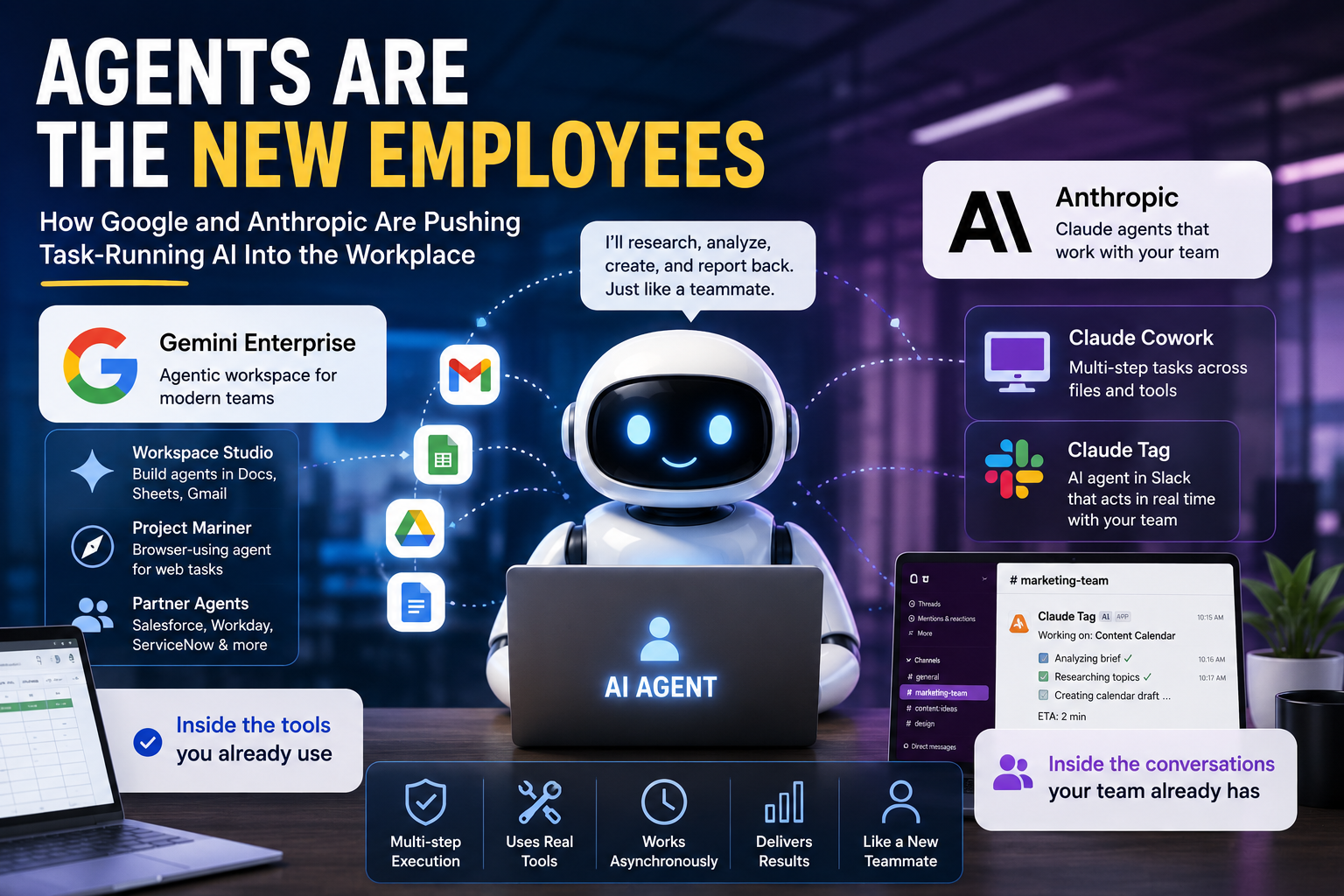
Quick summary: Google and Anthropic are no longer selling you a chatbot that answers questions they’re selling you an AI agent that logs into your tools, does multi-step tasks, and reports back like a junior teammate would. Google’s push is called Gemini Enterprise (built on the old Agentspace and Vertex AI), and Anthropic’s is Claude Cowork and Claude Tag, its Slack-based agent. If you run a small business, manage a team, or freelance in India, this shift matters because it changes what “using AI” even means.
I’ve been testing both ecosystems for the past few months, mostly on real client work content calendars, spreadsheet cleanup, and a bit of code review. This article is my honest, hands-on take on where things stand, what’s genuinely useful, and where the hype outruns the reality.
What Does “AI Agent” Actually Mean Here?
Let’s get the definition out of the way first, because “agent” gets thrown around loosely.
A task-running AI agent is different from a regular chatbot in three ways:
- It takes multiple steps on its own instead of waiting for you to prompt each action.
- It uses tools email, spreadsheets, code repos, Slack channels, browsers rather than just generating text.
- It can work asynchronously, meaning you assign it something and check back later, similar to delegating to a colleague.
That’s the “new employee” framing in the headline. You’re not typing a question and reading an answer anymore. You’re assigning a task and reviewing the output.
Google’s Bet: Gemini Enterprise and Agentic Workspace
Google consolidated its agent tools into a single product called Gemini Enterprise, which absorbed the earlier Agentspace platform and rebranded parts of Vertex AI into what it calls the Gemini Enterprise Agent Platform. Google Agentspace, the employee-facing AI assistant, has been absorbed into a unified product called Gemini Enterprise, alongside a no-code agent builder for Google Workspace called Workspace Studio.
A few pieces worth knowing about if you’re a Workspace user:
- Workspace Studio lets non-coders build simple agents inside Docs, Sheets, and Gmail without writing scripts.
- Project Mariner is Google DeepMind’s browser-using agent that can fill forms, do research, and complete shopping-style tasks on the open web. It runs on cloud-based virtual machines and can handle multiple tasks in parallel, and is available to Google AI Ultra subscribers.
- Partner agents from companies like Salesforce, Workday, and ServiceNow now plug directly into the Gemini Enterprise platform, so a small business using any of these tools may already have agentic features available without installing anything new.
If you’re an Indian marketer or student already living inside Gmail, Sheets, and Google Meet, this is the more “invisible” way agents will reach you not as a new app to download, but as a button that quietly appears inside tools you already use every day.
A Quick Walkthrough: Trying an Agent Inside Sheets
Here’s roughly how a Workspace Studio-style task plays out in practice:
- Open a Google Sheet with, say, a list of leads and their email addresses.
- Describe the task in plain language “clean up duplicate rows, standardize phone number formats, and flag any missing emails.”
- The agent runs the multi-step cleanup on its own and shows you a summary of what it changed.
- You review, accept or reject changes, and move on.
The genuinely useful part is step 4 you’re reviewing work, not doing it line by line. The catch is that you still need to check the output carefully, especially with anything involving numbers or client data. I’ve caught small formatting mistakes that would have gone unnoticed if I’d trusted the output blindly.
Anthropic’s Bet: Claude Cowork and Claude Tag
Anthropic’s approach leans into making Claude feel like a coworker rather than a search box. Two products matter most here:
Claude Cowork is a desktop-first, multi-step task agent built for non-developers things like research, document drafting, and workflows spanning several files and tools. It recently expanded to mobile and web access on paid plans. Anthropic’s Claude now has enhanced integration with Google Workspace, letting it interact directly with Gmail and Google Drive, while Claude Cowork the tool that plans, executes, and completes multi-step workflows is now accessible via mobile and web on all paid accounts.
Claude Tag takes a different angle: instead of a private one-on-one chat, it puts the agent directly inside a shared Slack channel. Rather than a private back-and-forth, Claude Tag shows up in the open, logging its task status directly inside the communication window so multiple employees can monitor the live execution steps. If an administrator turns on its “ambient” mode, the agent can monitor inactive threads and track tasks autonomously without needing real-time prompting from a person.
This is a meaningfully different philosophy from Google’s. Google is folding agents into individual documents and apps. Anthropic is folding them into team conversation spaces, treating the agent almost like a visible team member whose work everyone can see.
Where This Gets Interesting for Small Teams
If you run a small agency or a startup team in India that already lives on Slack, Claude Tag effectively becomes a shared assistant the whole team can @mention not something locked to one person’s account. That’s useful for handing off recurring work like weekly report drafts, competitor research summaries, or first-pass customer support replies, with the whole team able to see progress instead of one person acting as a bottleneck.
Google vs Anthropic: How the Approaches Differ
| Aspect | Google (Gemini Enterprise) | Anthropic (Claude Cowork / Tag) |
|---|---|---|
| Primary surface | Google Workspace apps, browser agent | Desktop/mobile app, Slack |
| Agent building | No-code builder (Workspace Studio) | Pre-built agent behaviors, connectors |
| Visibility of work | Mostly individual, document-based | Shared, team-visible (Slack) |
| Best fit for | Teams already deep in Google ecosystem | Teams already deep in Slack, coding-adjacent work |
| Known limitation | Still requires review of automated actions | Requires trust in autonomous “ambient” monitoring |
Neither company is claiming these agents replace human judgment. Both explicitly position them as handling the repetitive, multi-step grunt work while a person still reviews and approves outcomes at least for now.
Why This Matters for Indian Users Specifically
A lot of Indian small businesses and freelancers run lean often it’s one person doing marketing, admin, and client communication all at once. Task-running agents are genuinely relevant here because:
- Time zones aren’t a blocker. Asynchronous agents can work on a task overnight and have a draft ready by morning IST.
- Tool sprawl is common. Many small teams juggle Google Sheets, WhatsApp Business, and Slack or Notion. Agents that plug into existing tools reduce the need to learn a whole new platform.
- Pricing still matters. Most of these agentic features currently sit behind paid tiers (Google AI Ultra, Claude paid plans). Free tiers typically get a limited or no-agent experience, so budget carefully before assuming you’ll get full agentic capability for free.
The Honest Limitations
I don’t want to oversell this. A few things I’ve run into personally:
- Agents can still misread ambiguous instructions and confidently do the wrong thing across several steps before you notice.
- Handing an agent access to email or Drive means trusting it with sensitive data worth checking your organization’s data governance settings before turning on broader permissions.
- Multi-step agent runs can take noticeably longer than a single chatbot reply, so they’re not always the faster option for quick, simple tasks.
- Features, pricing, and product names in this space are changing fast. What I’ve described here reflects the state of things as of August 2026, and both companies are likely to rename, merge, or update these tools again.
None of this means the tools aren’t worth using it just means “set it and forget it” isn’t the right mental model yet. Review the work, the same way you’d check a new employee’s first few weeks of output.
FAQ
Is Claude Cowork the same as ChatGPT’s agent mode? No. Claude Cowork is Anthropic’s own multi-step task agent, separate from OpenAI’s tools. It’s built specifically around Claude’s models and Anthropic’s own connectors, though all major AI companies are building similar agentic features right now.
Do I need a paid plan to use these AI agents? In most cases, yes. Full agentic features like Claude Cowork’s expanded mobile access or Google’s Project Mariner are generally limited to paid subscription tiers, though this can change as the products mature.
Which is better for a small business in India – Google’s agents or Anthropic’s agents? It depends on what you already use daily. If your team runs on Gmail, Sheets, and Docs, Google’s Gemini Enterprise tools integrate more naturally. If your team communicates on Slack or does more coding-heavy work, Anthropic’s Claude Tag and Cowork tend to fit better.
Are AI agents going to replace human employees? Not based on what either company is currently claiming. Both frame these tools as handling repetitive, multi-step tasks under human review, not as autonomous replacements for judgment-heavy roles.
Try It Yourself
If you want to see this for yourself without any commitment, start small: pick one repetitive task you do weekly cleaning a spreadsheet, drafting a first-pass email reply, or summarizing a document and try running it through Claude Cowork’s free or trial tier, or through Gemini in a Google Doc you already have open. Compare how much manual review the output actually needs before you decide whether to bring an agent into your regular workflow.
— Sujith