If you have shopped online in India this year, you have probably noticed something odd. You are typing fewer product names into search bars and typing more full sentences into chat windows instead. That shift has a name: agentic commerce. And the tools driving it AI shopping agents built into ChatGPT, Perplexity, Amazon’s Rufus, and a growing list of retail apps are quietly rewriting how people research, compare, and buy things online.
I have been testing these tools for a few months now, from asking ChatGPT to shortlist a laptop under a fixed budget to letting Rufus track a price drop on Amazon India. This article is a practical, no-hype look at what agentic commerce actually is, which tools are worth your time in 2026, and where they still fall short.
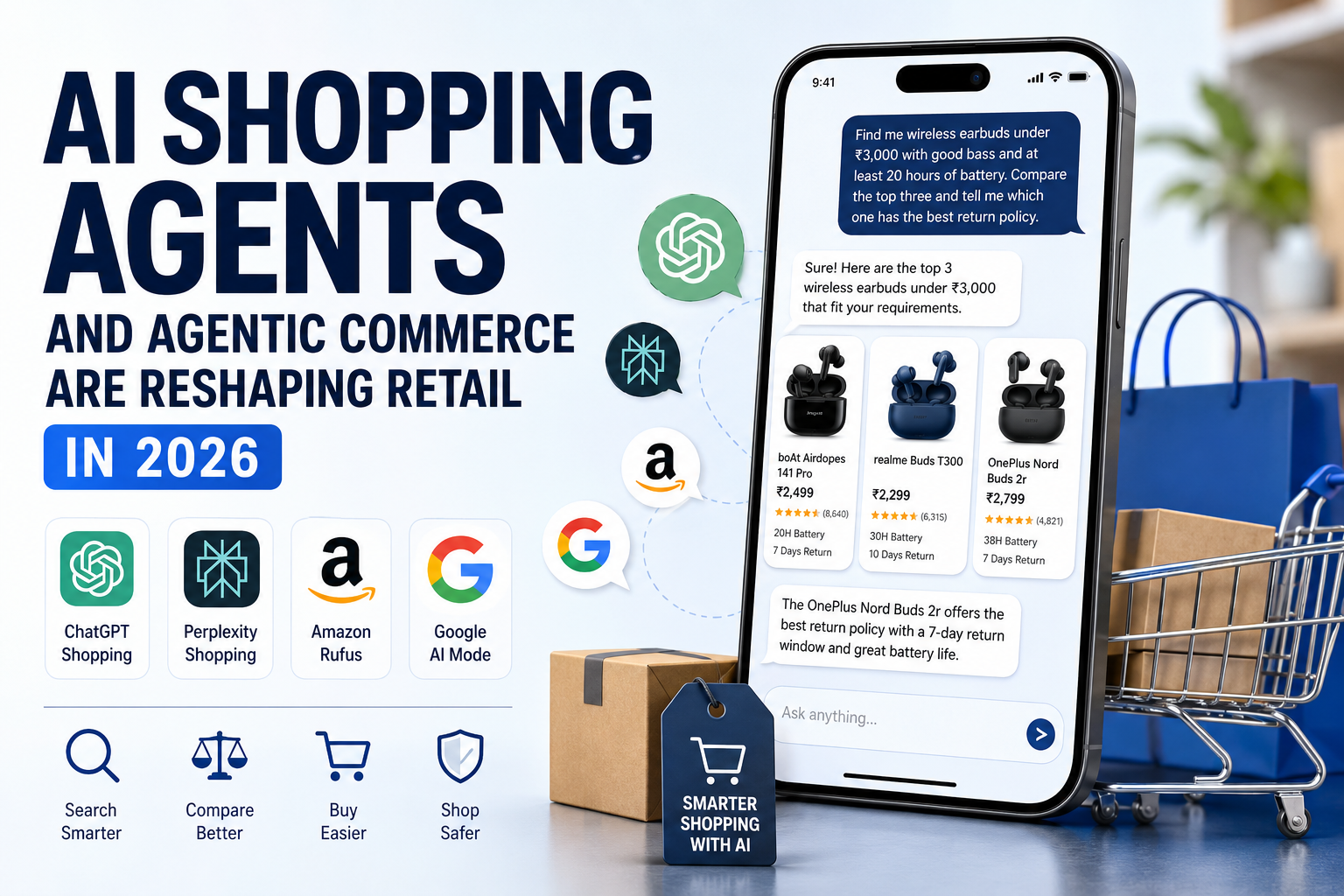
Quick answer: AI shopping agents are chat-based assistants that can search, compare, and in some cases complete a purchase for you, instead of you clicking through ten browser tabs yourself. In 2026, the biggest names are ChatGPT Shopping, Perplexity’s shopping and checkout features, Amazon’s Rufus, and Google’s AI Mode shopping tools each at a different stage of letting AI actually pay for things on your behalf, not just recommend them.
What “Agentic Commerce” Actually Means
Agentic commerce is the umbrella term for AI systems that can take multi-step actions toward a shopping goal not just answer a question, but act on it. Think of the difference between these two requests:
- Search-style query: “best wireless earbuds under ₹3,000”
- Agentic query: “Find me wireless earbuds under ₹3,000 with good bass and at least 20 hours of battery, compare the top three, and tell me which one has the best return policy.”
The second one asks the AI to reason, compare, and make a judgment call that’s the “agent” part. Some tools go a step further and can actually place the order using a saved payment method, with your confirmation at the final step.
Why This Matters for Indian Shoppers Right Now
A few reasons this is worth paying attention to in 2026, especially if you run a small business, sell on Amazon or Flipkart, or create content around shopping and reviews:
- Discovery is moving away from traditional search. People are asking chatbots for recommendations instead of typing keywords into Google, which changes how products get found.
- Reviews and comparisons are being summarized, not clicked through. If your blog or store listing isn’t structured clearly, an AI agent may skip it entirely when building its answer.
- Checkout is starting to happen inside the chat window. A few large platforms have piloted “buy now” style flows directly inside AI chat, though rollout has been uneven and some initiatives have already been scaled back.
The Major Players in 2026 (And What They’re Actually Good At)
ChatGPT Shopping
OpenAI built shopping recommendations directly into ChatGPT, letting it suggest products with images, prices, and links based on your conversation. OpenAI also experimented with in-chat checkout through a payments partnership, starting with a small set of merchants. In my own testing, ChatGPT is genuinely strong at the research phase narrowing down options, explaining trade-offs between two similar products, and adjusting recommendations when you add a new constraint mid-conversation. Where it’s weaker is consistency: it doesn’t have access to every retailer’s live catalog, so it can miss sellers (Amazon listings, for instance, are often not visible to it), and prices shown in chat should always be double-checked on the actual retailer site before you buy.
Perplexity Shopping
Perplexity built its shopping features around fast, source-cited product discovery, and has experimented with letting users complete purchases without leaving the chat, in partnership with select merchants and payment providers. I use Perplexity mostly for comparison research asking it to pull spec sheets side by side because it tends to show where information came from, which is useful when you want to verify a claim before spending money.
Amazon Rufus
Rufus is Amazon’s own AI shopping assistant, built into the Amazon app. Unlike ChatGPT or Perplexity, Rufus already knows your order history, your saved payment methods, and Amazon’s live inventory, so it can move from “recommend” to “buy” much more smoothly. Amazon has also tested features that let Rufus place an order automatically once a price drops to a level you set. This is the most “purchase-first” of the tools you’re usually already in a buying mindset when you open Rufus, whereas ChatGPT and Perplexity are more often used earlier, during research.
Google’s AI Mode and Shopping Features
Google has been layering agentic shopping capabilities into AI Mode and Search, pulling from its enormous product listings database (Shopping Graph) and, in some cases, allowing checkout with partner retailers. Because Google already indexes most of the products you’d find through a regular search, its shopping AI tends to have the widest catalog coverage of any of these tools.
A Simple Walkthrough: Using an AI Agent to Shop Smart
Here’s a workflow I actually use when I need to buy something and don’t want to waste an evening comparing tabs:
- Give the AI a real constraint, not just a category. Instead of “suggest a phone,” try “suggest a phone under ₹20,000 with a good camera for low light, and I don’t care about gaming performance.”
- Ask it to compare, not just list. Follow up with “compare the top 2 on camera quality and battery life only.”
- Ask for the catch. A good habit: “what’s the downside of each option you just mentioned?” AI agents will usually surface trade-offs if you explicitly ask, even though they don’t always volunteer them.
- Verify price and stock on the actual retailer site. AI-shown prices can lag behind real-time changes, especially during sales.
- Only let it checkout automatically if you trust the merchant and the payment flow. Where in-chat checkout exists, it’s usually opt-in and limited to specific partner retailers read what account or card details it’s actually using before confirming.
Limitations You Should Know About
No AI shopping tool in 2026 is a “set it and forget it” solution, and it’s worth being honest about the gaps:
- Catalog coverage is incomplete. Some large retailers restrict AI crawlers from indexing their listings, so an agent’s recommendations may simply be missing major sellers, including some of the biggest ones.
- In-chat checkout is still early and inconsistent. Some ambitious checkout features launched with fanfare have since been scaled back or pivoted, so don’t assume every AI tool can actually complete a purchase for you many are still discovery-only.
- Recommendations can reflect what’s easiest to surface, not what’s objectively best. Treat AI suggestions as a strong starting shortlist, not a final verdict.
- Prices, features, and free-tier limits change often. What a tool offers for free today may shift in a few months, so it’s worth rechecking before you rely on a specific feature for business use.
FAQ
Is agentic commerce safe to use for payments in India? Where checkout is offered through AI chat, it typically routes through an established payment partner rather than the AI storing your card directly. Even so, treat any in-chat “buy” button with the same caution as a new website check the merchant name, use trusted payment methods, and avoid auto-purchase settings unless you’re comfortable with the price threshold you’ve set.
Do I need a paid subscription to use AI shopping agents? Not necessarily. Basic product research and comparison features are generally available on free tiers of ChatGPT, Perplexity, and Google’s AI tools, while Amazon’s Rufus is free within the Amazon app. Paid tiers usually unlock faster responses, more queries, or access to more advanced models rather than shopping-specific features.
Will AI shopping agents replace comparison websites and reviews? Not entirely, at least not yet. AI agents are good at summarizing and comparing, but they still often pull from and cite reviews, spec sheets, and comparison content written by humans. Well-structured, honest review content is arguably more valuable now, since AI tools favor content that’s easy to extract and verify.
Which AI shopping agent should a small business owner pay attention to first? If you sell online, start by checking whether your product listings are visible to AI crawlers at all some platforms block them by default. After that, keep an eye on whichever agent your target customers already use daily, since that’s where your discovery traffic is most likely to shift first.
Try This Next
Pick one purchase you’re actually planning to make this week a phone, a course, a kitchen appliance, anything and run it through the five-step workflow above using ChatGPT or Perplexity. Then compare that shortlist against what you’d have found by manually searching for twenty minutes. You’ll get a real feel for where these agents genuinely save you time, and where you still need to double-check things yourself.
— Sujith