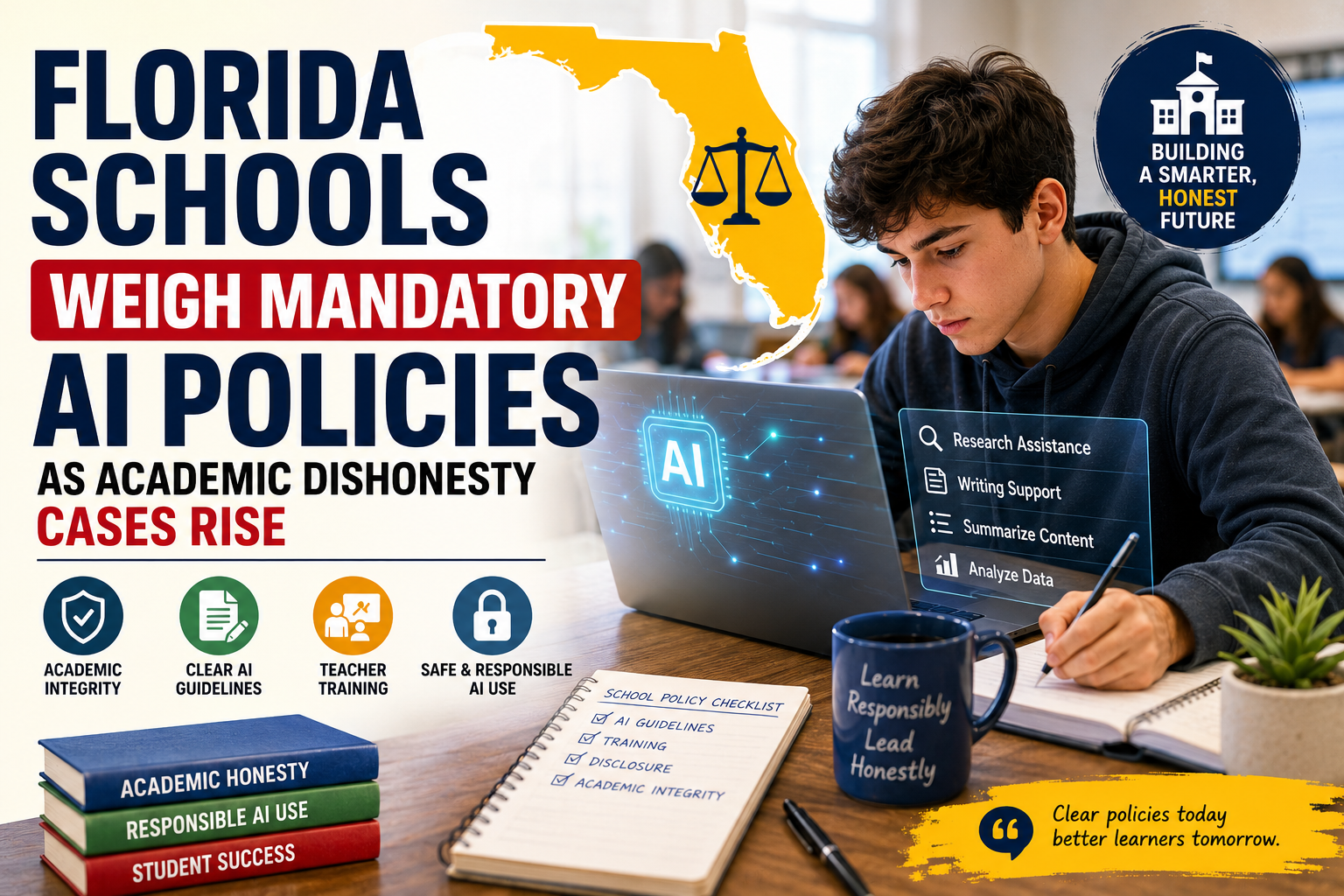
If you have been following education news lately, you have probably noticed a pattern: schools that once treated ChatGPT and other AI tools as a distraction are now scrambling to write actual rules around them. Florida is the latest and probably the most visible example of this shift. As academic dishonesty complaints tied to AI keep climbing, the state’s education board is weighing whether every public and charter school should be required to address artificial intelligence in their internet safety policies.
I write about AI tools for a living, and I get versions of this question from Indian parents, teachers, and college students almost every week “should schools ban ChatGPT, or should they teach us to use it properly?” Florida’s ongoing policy debate is a useful case study, because it shows what happens when a large education system tries to regulate a tool that is already sitting on every student’s phone.
Quick answer: Florida is moving toward requiring all public and charter schools to formally address AI use inside their internet safety and academic honesty policies, after a wave of individual district rules failed to create consistency statewide. The state board discussed a proposed rule change in early August, while several districts, including Duval, Clay, St. Johns, Volusia, and Palm Beach County, have already adopted their own AI guidelines ahead of the 2026-27 school year.
Why This Is Happening Now
Generative AI tools like ChatGPT, Claude, and Gemini went from novelty to daily habit for students in a matter of two or three years. Essays, lab reports, discussion posts, even math homework a student can now generate a plausible first draft in seconds. Teachers noticed the shift almost immediately: writing that felt oddly polished, structure that repeated the same generic patterns, and citations that occasionally did not exist.
Florida had not incorporated clear, consistent discipline guidelines for AI use across the state, even though many districts were trying to apply older cheating and technology-misuse rules to this new problem. That gap is exactly what the proposed statewide rule is trying to close.
Florida’s State Board of Education held a workshop in early August to discuss a proposed rule that would require every public and charter school to address artificial intelligence within their internet safety policies, and several Northeast Florida districts, including Clay County and St. Johns County, had already adopted their own AI guidance by that point, with Duval County revising its student code of conduct specifically to cover AI-related academic dishonesty.
There is also a legislative angle. A state Senate bill introduced this session would go further than internet safety policy alone it would require the State Board of Education to adopt statewide AI standards, direct the Department of Education to track student AI use and teacher-reported academic dishonesty cases, and mandate teacher training on AI and AI detection tools. Whether or not that bill passes as written, it signals where the conversation is heading: from scattered district memos to a coordinated statewide framework.
What Individual Florida Districts Are Already Doing
Even before any statewide mandate, districts have not been sitting still. The patterns are worth understanding because they preview what a statewide policy will probably look like.
Palm Beach County: Clear Consequences, Approved Tools Only
Palm Beach County approved its AI use policy in April, banning AI on standardized tests and prohibiting AI-generated deepfakes altogether. Students who break the rules can face a zero grade, parental notification, or suspension for repeat offenses, and the district treats AI misuse the same way it treats any other academic honesty violation. On the staff side, teachers are restricted to AI tools that have been vetted by the district’s own Technology Clearinghouse Committee a detail that matters, because it shows districts are worried about data privacy and vendor trust, not just student cheating.
Volusia County: Permission-Based, Not a Blanket Ban
Volusia County’s policy, first adopted in 2024, allows AI for things like research, tutoring, lesson planning, and personalized learning, but students are still expected to produce their own work, and using AI without authorization can count as cheating. For the 2026-27 year, the district is leaning into training through its own “Volusia AI Academy,” building teacher familiarity with district-approved AI tools rather than pretending the technology will go away.
Seminole and Lake County: Disclosure and Written Guidelines
Other Central Florida districts are taking a “guardrails, not bans” approach. New rules in some districts let students use AI for background research before writing an assignment, but they cannot submit AI-produced work for a grade without written permission from the instructor, and teachers are expected to hand out written guidelines on acceptable AI use for their own classrooms. Lake County has taken a slightly different path rather than a fully board-adopted AI policy, it built flexible AI guidance into its existing Student Code of Conduct for the current academic year while a formal policy is finalized, and it has been training teachers on tools like MagicSchool and shifting toward Google’s Gemini, which is integrated directly into Docs and Drive.
The Real Problem Isn’t Just Cheating
This is the part that often gets missed in “students are cheating with AI” headlines. Education researchers keep pointing out that academic dishonesty is only one slice of the risk.
Dr. Vanessa Dennen, a Florida State University professor who studies technology-based learning, has raised the question of what happens when a teacher uploads student essays into an AI tool for grading help whether student names and personal details end up stored somewhere outside the school’s control. That is a data privacy issue, not an academic honesty issue, and it applies to teachers as much as students.
There is a second, quieter problem: detection tools are not reliable enough to be the final word. AI detection tools intended to flag machine-generated writing can produce false positives and false negatives, and there is documented concern that these errors disproportionately affect students who are non-native English speakers. That is a serious fairness issue a policy that leans too heavily on an AI detector without human review risks punishing honest students who simply write in a more formal or formulaic style.
What This Means If You Are a Student, Teacher, or Parent (Even Outside Florida)
I know most readers here are in India, not Florida, but the underlying dilemma is universal Indian schools, colleges, and even coaching institutes are having the exact same conversation right now, just a step or two behind. A few practical takeaways from watching Florida’s process closely:
- “No AI” policies rarely survive contact with reality. Districts that started with an outright ban have mostly moved toward permission-based or disclosure-based models within a year or two.
- Written classroom guidelines matter more than blanket state rules. The most functional approach seems to be a general district policy paired with clear, subject-specific instructions from each teacher about what is and isn’t allowed for a given assignment.
- Detection tools should never be the sole basis for a discipline decision. If you are a teacher, treat an AI-detector flag as a conversation starter with the student, not a verdict.
- Data privacy deserves the same attention as cheating. Before uploading any student writing, personal essays, or identifiable data into a public AI tool, check whether that tool retains or trains on your inputs. Most major tools, including ChatGPT and Claude, offer settings or enterprise/education tiers with stronger data controls but the free consumer versions may not offer the same protections by default, and settings can change, so it’s worth checking current terms rather than assuming.
A Simple Framework for Using AI Responsibly in Schoolwork
Whether you’re a student in Florida or a college student in Chennai, this rough framework keeps you on the right side of most academic honesty policies:
- Use AI for brainstorming, outlining, or explaining a concept you don’t understand this is almost universally allowed.
- Do not paste AI output directly into a submitted assignment unless your teacher has explicitly said that’s permitted.
- If a policy allows AI with disclosure, actually disclose it a short note like “Used ChatGPT to help outline this essay’s structure” takes ten seconds and protects you.
- Always fact-check anything an AI tool gives you before you submit it. Hallucinated citations and made-up statistics are still common, even in the newest models.
FAQ: Florida Schools and AI Policies
Q: Is Florida planning to ban AI tools in schools? No. Based on the current district-level policies and the proposed state rule, the direction is toward regulation and disclosure requirements rather than an outright ban. Districts are focused on when and how AI can be used, not eliminating it entirely.
Q: Which Florida districts already have AI policies in place? Districts including Duval, Clay, St. Johns, Volusia, Palm Beach County, and Seminole have adopted some form of AI guidance, while others like Lake County have built interim guidance into their existing code of conduct while a formal policy is finalized.
Q: What happens to a student caught misusing AI in Palm Beach County? Consequences can include a zero grade on the assignment, notification to parents, and suspension for repeat violations, following the district’s existing academic honesty framework.
Q: Are AI detection tools accurate enough to be trusted for discipline decisions? Not entirely. These tools can produce false positives and negatives, and research has flagged particular risk for non-native English speakers being incorrectly flagged. Most sound policies treat a detector result as one data point, not final proof.
Try This Next
If you’re a teacher or a student trying to figure out where you stand, don’t wait for a formal policy to land in your inbox. Pull up your school or college’s current academic honesty policy today, search it for the word “AI,” and see what if anything it actually says. If it’s silent on the topic, that silence is exactly the gap Florida is now trying to close, and it’s worth raising with your teacher or administrator before it becomes a problem rather than after.