If you have spent any time on LinkedIn or YouTube over the last year, you know the drill. A slick five-minute demo, a founder saying “this will change everything,” and a waitlist link at the end. That formula used to be enough to raise funding, get press coverage, and land enterprise deals. It is not enough anymore.
In short: businesses evaluating AI tools in 2026 are no longer swayed by polished demos alone they want documented accuracy, real pilot results, security compliance, and pricing that survives actual usage. If you are choosing an AI tool for your team, look for evidence of real-world performance, not just a smooth walkthrough video.
I run a small content and marketing operation out of Chennai, and over the past two years I have tested, adopted, and eventually dropped more AI tools than I can count on both hands. What I have noticed recently is a real shift in how buyers including me evaluate these products. Let me walk you through what changed, why it matters, and how you can apply this stricter mindset the next time someone pitches you an AI tool.
Why Demos Used to Be Enough
Early in the generative AI wave, around 2023, everything felt new. A chatbot that could write a paragraph of decent marketing copy, or an image generator that could produce a passable logo concept, was genuinely impressive on its own. Demos worked because the bar was low and novelty carried a lot of weight.
Founders knew this. Product launches were built around a single “wow moment” watch the AI write your email, watch it summarise your PDF, watch it generate a website in ten seconds. Nobody asked too many follow-up questions because there was no frame of reference yet.
What Changed in the AI Market
A few things happened at once, and together they raised the bar significantly.
1. Buyers got burned
Plenty of businesses signed up for AI tools based on a demo, rolled them out to their teams, and then discovered the tool broke down outside the narrow scenario shown in the video. A chatbot that handled one sample customer query beautifully might fumble a real conversation with edge cases, regional language mixing, or ambiguous intent. Once a few teams got burned on subscription costs with little to show for it, procurement teams started asking harder questions before signing off.
2. The market got crowded
There are now multiple credible options for almost every AI use case writing, coding, customer support, data analysis, image generation. When you had one or two players, differentiation was easy. Now that Claude, ChatGPT, Gemini, and a dozen specialised tools all claim to do similar things, a demo alone cannot tell you which one will actually perform for your specific workflow.
3. Enterprise and government scrutiny increased
As AI tools started handling sensitive data customer records, financial documents, internal strategy data security and compliance stopped being a footnote. Businesses now ask about data retention policies, where servers are hosted, whether your inputs train the model, and whether the vendor has any relevant certifications. A flashy demo says nothing about any of this.
4. Pricing pain became real
Many AI products price based on usage tokens, API calls, seats, or credits. A demo never shows you what your actual monthly bill looks like once fifty employees start using a tool daily. Finance teams have started asking for real cost projections before approving anything, not just a “starting at” price on a landing page.
What “Proof” Actually Looks Like
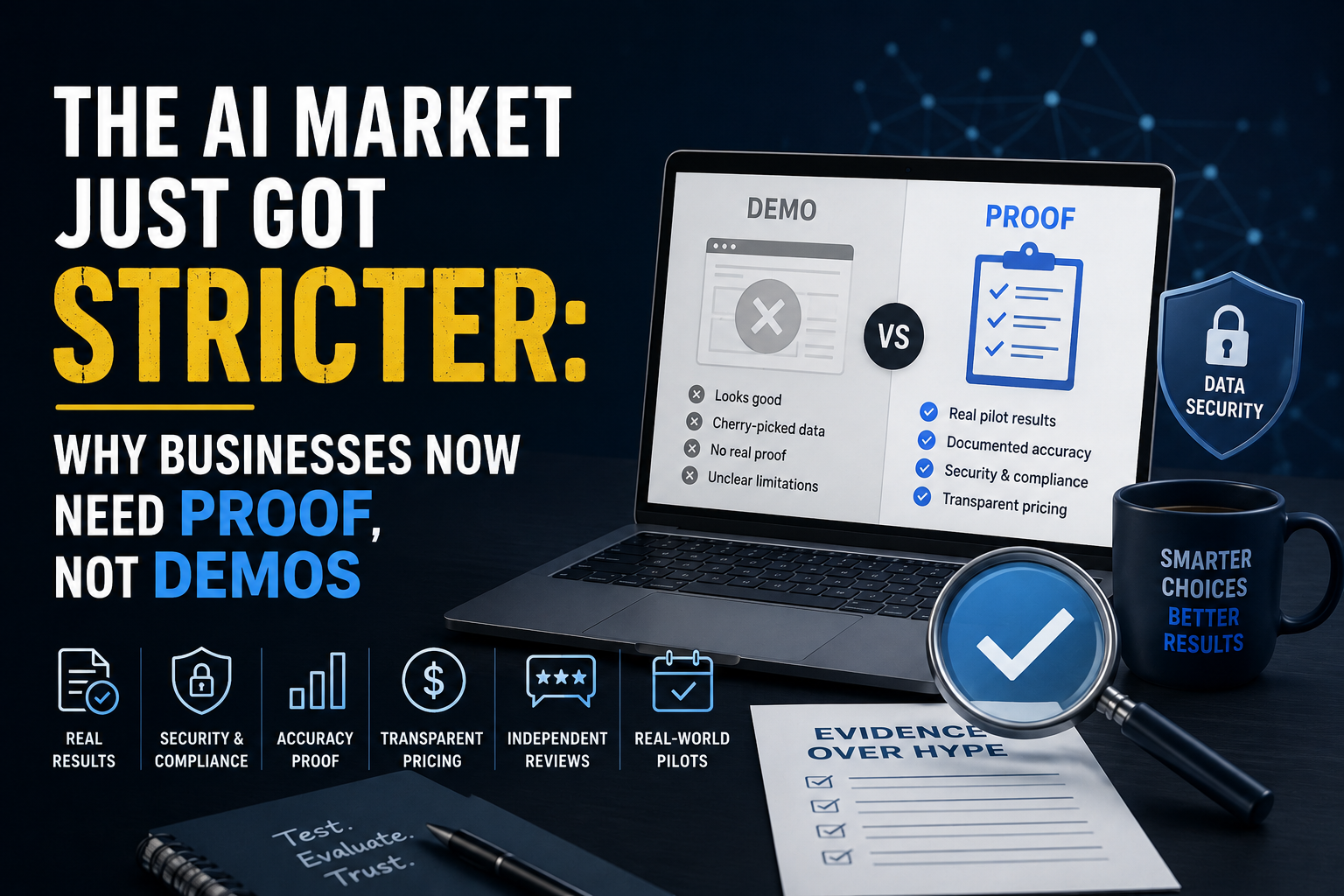
So if demos are out, what are businesses asking for instead? Based on what I have seen in my own vendor evaluations and conversations with other small business owners, here is the shortlist.
- Pilot results with your own data. Not the vendor’s cherry-picked sample dataset your actual customer queries, your actual documents, your actual tone of voice.
- Documented limitations. A vendor who openly tells you where the tool struggles (long documents, certain languages, real-time data) is more trustworthy than one who claims it can do everything.
- Transparent pricing tiers. Clear breakdowns of free vs paid plans, what counts as a “message” or “credit,” and what happens when you exceed limits.
- Security and data-handling details. Whether your prompts and files are used for training, how long data is retained, and whether there is an enterprise-grade data protection option.
- Independent user feedback. Reviews, community forums, and case studies from people outside the vendor’s own marketing team.
- A trial period long enough to test real workloads, not just a sandbox with sample prompts.
A Practical Walkthrough: How I Evaluate an AI Tool Now
Here is the process I actually use before recommending any AI tool to a client or adopting it myself.
Step 1: Skip the demo, go straight to the free tier. Most credible tools ChatGPT, Claude, Gemini offer a usable free version. I ignore the marketing video and go run my own test prompts immediately.
Step 2: Feed it a real task, not a toy example. Instead of asking it to “write a poem about my brand,” I give it an actual client brief, a messy spreadsheet, or a real customer email thread, and see how it handles ambiguity.
Step 3: Check where it breaks. Every tool has a failure point. I intentionally push it long documents, regional context, mixed English-Tamil phrasing to see where the quality drops.
Step 4: Compare pricing against my actual usage, not the advertised minimum. If I expect to send fifty prompts a day, I estimate what that costs on the paid tier, not the “starting at” number on the homepage.
Step 5: Read the fine print on data usage. For any tool touching client data, I check whether inputs are used for model training and whether there is a business or team plan with stronger privacy terms.
Step 6: Run a short pilot before full rollout. Even after all this, I run a one-to-two week pilot with a small part of the workflow before switching everything over.
This process takes a few hours instead of ten minutes watching a demo, but it has saved me from at least three tools that looked great on screen and performed poorly in practice.
The Trade-Offs Worth Knowing
To be fair to the vendors, none of this means demos are useless. A good demo still helps you understand a tool’s intended use case and interface quickly. The problem is treating a demo as sufficient proof of fit for your business.
It is also worth remembering that AI tools evolve fast. A limitation you find today say, weak performance on Indian regional languages or a low free-tier limit might be fixed in the next update. Pricing structures change often too, so always check the vendor’s current pricing page rather than relying on older reviews, including this one.
Why This Shift Is Good News for Everyone
A stricter market is not a bad thing for buyers. It pushes vendors to be more honest about limitations, publish clearer pricing, and compete on actual performance rather than marketing polish. For small businesses and freelancers in India especially, this means you can make smarter decisions without needing a large evaluation team you just need a slightly more disciplined process, like the one above.
FAQ
Q: Are AI demos completely useless now? No. Demos are still a fast way to understand a tool’s interface and intended use case. The issue is relying on a demo alone without testing it on your own real tasks and data.
Q: How long should a pilot test run before adopting an AI tool for my business? There is no fixed rule, but one to two weeks of real usage by the actual team members who will use it daily is generally enough to surface most issues.
Q: Is the free tier of tools like ChatGPT or Claude good enough to evaluate them? For many use cases, yes. Free tiers usually give you enough access to test quality and fit. For high-volume or team use, you will eventually need to test the paid tier to understand real costs.
Q: What is the single most important thing to check before adopting an AI tool for business use? How it handles your own real data and tasks not sample prompts from the vendor’s website. Everything else, including pricing and security, matters, but performance on your actual workflow is the deciding factor.
Your Next Step
Before you trust the next AI tool demo you see, pick one real task from your business a customer email, a report summary, a content brief and run it through the free tiers of two tools, say ChatGPT and Claude. Compare the outputs side by side on accuracy and tone, not on how impressive the interface looks. That fifteen-minute test will tell you more than any demo video will.